
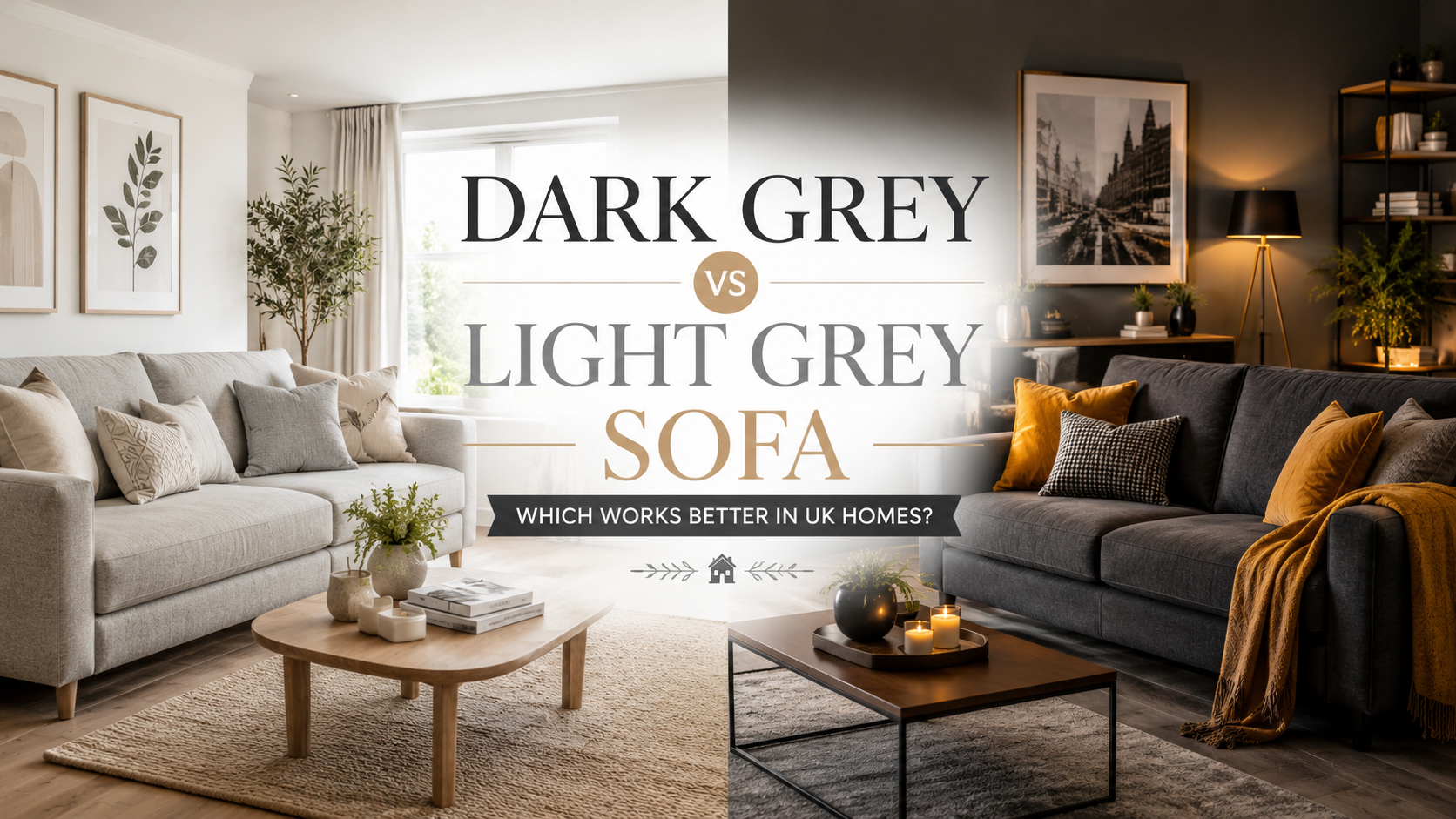
Quick Answer: A dark grey sofa hides marks better, adds depth, and suits busy family homes. A light grey sofa brightens smaller rooms, feels airier, and suits a softer, more relaxed palette. Your choice comes down to three things — your room size, how much natural light you get, and how the sofa will be used day to day.
There is a moment almost every UK sofa buyer faces. You’ve narrowed it down to grey. You know you want grey. But then the question creeps in — dark grey or light grey?
It sounds simple. It rarely is.
Both options are genuinely beautiful. Both are enormously popular in UK homes right now. And both have very different strengths that suit very different homes, lifestyles, and rooms.
This guide cuts through the confusion. By the end, you’ll know exactly which one is right for your living room — and why.
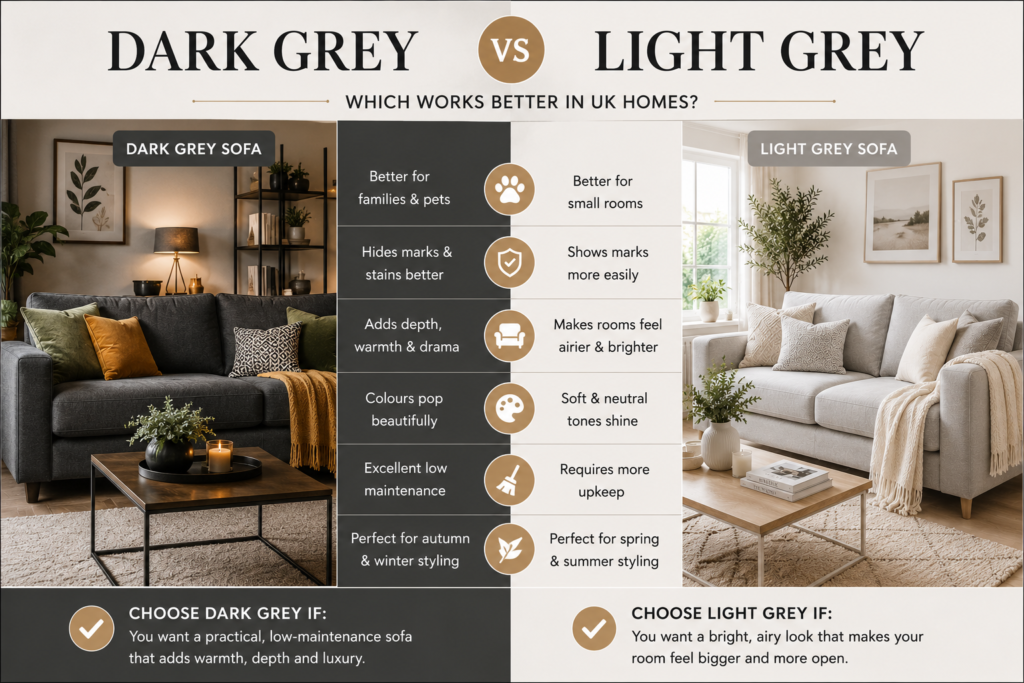
Dark Grey Sofa vs Light Grey Sofa: The Key Differences at a Glance
| Factor | Dark Grey Sofa | Light Grey Sofa |
|---|---|---|
| Practicality | Hides marks, stains, and daily wear better | Shows marks more easily |
| Room Feel | Adds depth, warmth, and drama | Makes rooms feel airier and more open |
| Best Room Size | Medium to large rooms | Small to medium rooms |
| Natural Light | Works in well-lit and darker rooms | Best in rooms with good natural light |
| Styling Versatility | Bold colours pop beautifully against it | Soft, pastel, and neutral tones shine |
| Family/Pet Friendly | Excellent — very forgiving | Less forgiving with heavy use |
| Timelessness | Classic and enduring | Elegant but shows age with marks |
| Seasonal Styling | Rich autumn/winter looks | Fresh spring/summer styling |
What Actually Makes Them Different?
Before we go deeper, it helps to understand what we mean by each shade.
Dark grey covers charcoal, slate, gunmetal, and deep anthracite tones. These are rich, deep colours with real visual weight. They absorb light rather than reflect it — which gives a room depth and a feeling of considered, deliberate style.
Light grey covers dove grey, silver grey, pale ash, and soft pewter tones. These are closer to near-white on the colour spectrum. They reflect light, feel open and airy, and create a softness that darker shades simply cannot replicate.
The gap between them isn’t just visual. It affects how a room feels to live in, how easy the sofa is to maintain, and how much flexibility you have when styling around it.
💡 Pro Tip: Always look at fabric swatches in your own room — not in a showroom. UK living rooms vary enormously in natural light, and a colour that looks perfect in a bright showroom can feel completely different in a north-facing lounge. Order swatches and live with them for a day before deciding.
The Case for a Dark Grey Sofa
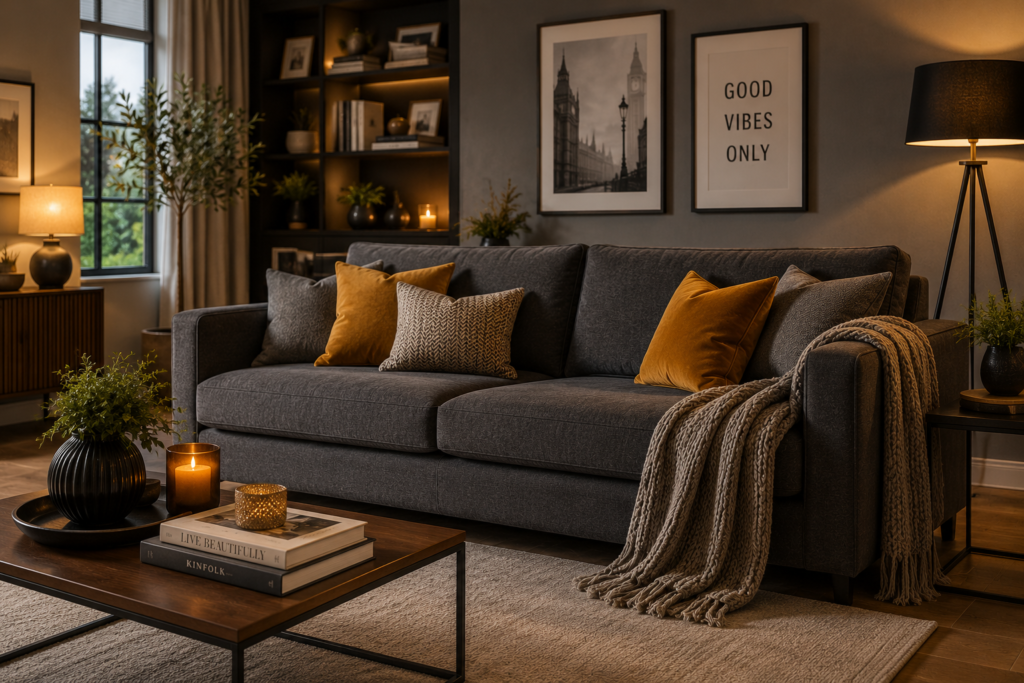
It Is Genuinely Practical for Real UK Life
Let’s be honest about something. Sofas get used hard in most UK homes. Remote controls get lost in cushions. Mugs get placed on armrests. Children sit in school clothes. Pets settle where they please.
A dark grey sofa handles all of this with remarkable grace. Marks, light stains, dust, and the general signs of daily living are far less visible on a dark grey fabric than on a lighter shade. This is one of the biggest reasons it remains such a consistently popular choice across UK homes.
It’s not about being lazy with cleaning. It’s about choosing a sofa that works for real life — and still looks great doing it.
It Anchors a Room Beautifully
There’s something deeply satisfying about a dark grey sofa in a well-lit living room. It anchors the space. It gives the room a centrepiece with real visual weight.
In homes with light walls, wooden flooring, and good natural light — which describes a huge proportion of modern UK new builds and renovated Victorian terraces — a dark grey sofa creates a balance that lighter sofas sometimes struggle to achieve. The room feels grounded. Considered. Finished.
Colour Pops Against It Like Nothing Else
If you love styling with cushions, throws, and accent colours — and most UK homeowners do — a dark grey sofa gives you a canvas that makes every colour sing.
Mustard yellow looks electric against dark grey. Burnt orange feels rich and warm. Dusty pink feels elegant. Forest green feels dramatic. Even simple cream cushions look stunning.
If you are comparing finishes as well as shades, velvet sofa fabric can change how either grey tone looks and feels in everyday use.
Light grey, by comparison, can sometimes feel washed out when paired with very pale accents. The contrast just isn’t there in the same way.
It Suits UK Autumn and Winter Perfectly
The UK is not a year-round sunshine country. Autumn and winter evenings are long, and living rooms need to feel warm and inviting during those darker months.
A dark grey sofa lends itself to the kind of layered, cosy styling that makes a room feel genuinely warm on a cold Tuesday night. A chunky knit throw in burnt orange. Velvet cushions in deep teal. Warm lamplight bouncing off a plush fabric surface.
Light grey, styled the same way, can sometimes feel slightly cold and stark in the depths of a British winter.
💡 Pro Tip: If you live in a north-facing room or a home that doesn’t get much natural daylight, a dark grey sofa can actually work better than you might expect — provided you balance it with warm lighting, light-coloured walls, and a lighter rug underneath. The key is contrast, not avoidance.
The Case for a Light Grey Sofa
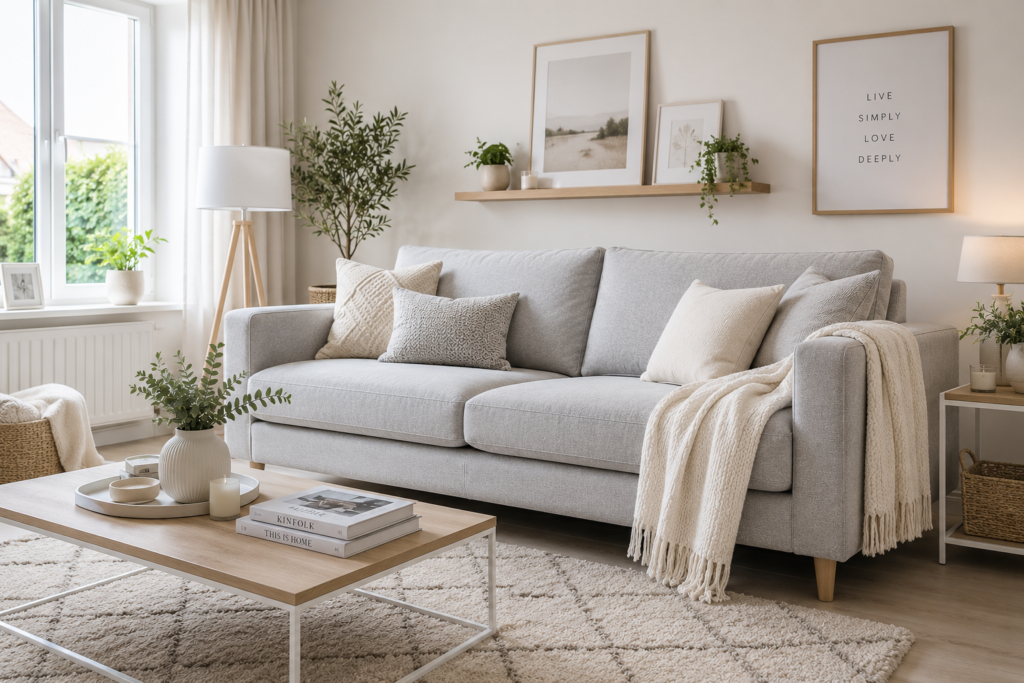
It Opens Up Smaller Spaces
If your living room is compact — and many UK flats and terraced houses have relatively modest living rooms — a light grey sofa can help the space feel larger and more open than it actually is.
Light colours reflect rather than absorb light. This reflection creates a sense of space and airiness that makes a room feel more generous. A dark grey sofa in a very small room can occasionally make the space feel slightly heavy or enclosed if not carefully balanced.
For studio flats, small Victorian front rooms, and compact new-build lounges, a light grey sofa can be genuinely transformative.
It Creates a Soft, Elegant Palette
Light grey is one of the most graceful base colours in interior design. It sits beautifully with soft blush pinks, powder blues, sage greens, warm whites, and pale naturals.
If your aesthetic is calm, considered, and gently feminine — the kind of living room that feels like a sanctuary rather than a statement — a light grey sofa often delivers that feeling more naturally than dark grey.
Scandinavian-inspired interiors, soft modern aesthetics, and coastal-influenced UK homes all tend to suit a light grey sofa beautifully.
It Works Year-Round With Less Effort
Light grey has a natural freshness to it. In spring and summer, paired with linen cushions and cotton throws in pale natural tones, it feels breezy and light. In autumn and winter, warmer accessories can bring it depth without it ever feeling oppressive.
There’s an ease to light grey that works across all seasons with relatively little styling effort.
💡 Pro Tip: If you choose a light grey sofa, invest in quality fabric protection from day one. A good fabric protector spray reduces the absorption of spills and marks significantly — extending the life of a lighter sofa and keeping it looking its best for much longer.
The Room Size Question | The Most Important Decision Factor
If you are comparing sizes as well as shades, a 5 seater sofa can help you judge how each grey tone will look in a larger living room.
This is arguably the most important practical consideration.
Room size and natural light should guide your decision more than anything else.
Dark grey works best when:
- Your room is medium to large
- You have good natural light or warm artificial lighting
- You have light-coloured walls (white, cream, pale grey, warm stone)
- The sofa won’t dominate the entire visual field of the room
Light grey works best when:
- Your room is small to medium
- Natural light is limited or the room feels slightly dark
- You want to create an open, airy, spacious feel
- Your walls are mid-toned or slightly darker
The golden rule in UK interior design is contrast. A light sofa against dark walls. A dark sofa against light walls. When both the sofa and the walls are the same depth of tone, the room loses all sense of visual interest and dimension.
Family and Pet Considerations
If you have children or pets — and a huge proportion of UK households do — this section matters enormously.
Dark grey wins this comparison comfortably. It hides everyday marks, muddy paw prints, food residue, and general signs of family life far better than light grey. You can genuinely enjoy your sofa without being constantly on alert.
Light grey requires more vigilance. It isn’t impractical — particularly in performance or treated fabrics — but it demands more attention to maintain its appearance in a busy household.
💡 Pro Tip: If you love the look of a light grey sofa but have children or pets, look specifically for light grey sofas in performance fabrics — chenille, treated velvet, or stain-resistant weaves. These fabrics offer the look of a lighter sofa with considerably more resilience in daily use.
Styling Differences Side by Side | Dark Grey Sofa vs Light Grey Sofa
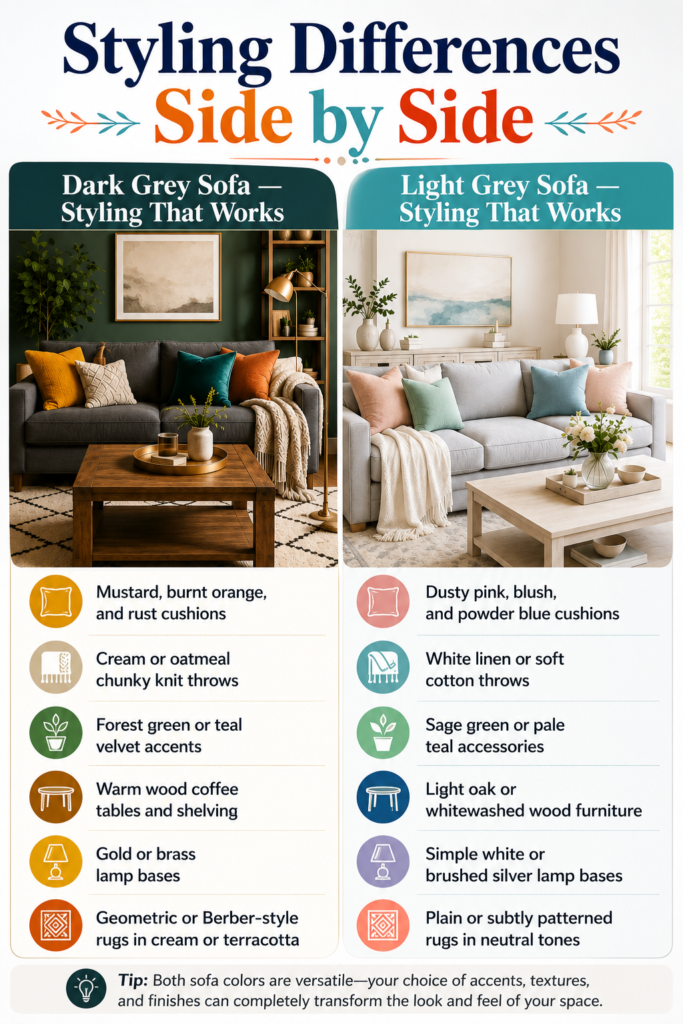
Dark Grey Sofa — Styling That Works
- Mustard, burnt orange, and rust cushions
- Cream or oatmeal chunky knit throws
- Forest green or teal velvet accents
- Warm wood coffee tables and shelving
- Gold or brass lamp bases
- Geometric or Berber-style rugs in cream or terracotta
Light Grey Sofa — Styling That Works
- Dusty pink, blush, and powder blue cushions
- White linen or soft cotton throws
- Sage green or pale teal accessories
- Light oak or whitewashed wood furniture
- Simple white or brushed silver lamp bases
- Plain or subtly patterned rugs in neutral tones
Which One Is More Timeless?
Both shades of grey are genuinely enduring choices. Neither is a trend — they’re established neutrals with staying power.
That said, dark grey has a slight edge in terms of long-term resilience. Because it hides signs of wear more effectively, a quality dark grey sofa will look good for longer without the same degree of maintenance. It also holds its visual impact as rooms around it change and evolve — new walls, new rugs, new accessories — because its depth and richness remain consistent.
Light grey, at its best, is equally timeless. But a light grey sofa that has seen significant use can begin to look tired more quickly than a dark equivalent in the same fabric.
Which One Should You Choose?
Here’s a straightforward framework to help you decide.
Choose a dark grey sofa if:
- You have children, pets, or a busy household
- Your room is medium to large with reasonable light
- You love rich, warm, layered styling
- You want a sofa that makes a confident statement
- You prefer deep, dramatic colour combinations
Choose a light grey sofa if:
- Your room is small or lacks natural light
- You prefer a soft, calm, restful aesthetic
- Your household is relatively quiet and careful
- You lean towards pastel and neutral colour palettes
- You want a sofa that feels fresh and light year-round
If you’re still genuinely undecided, dark grey is usually the safer long-term choice for most UK homes. It’s more practical, more forgiving, and arguably more versatile across different styling directions.
The FurniFolks dark grey sofa collection offers a wide range of fabrics — from plush velvet and crush velvet to chenille and jumbo cord — so you can find the exact texture and depth of dark grey that suits your home perfectly.
If you want to explore the full sofa range across different sizes and styles, the FurniFolks sofa sets collection is a great place to start.
Summing Up
Dark grey and light grey are both brilliant sofa choices — but they suit different homes, different lifestyles, and different priorities. Dark grey gives you practicality, depth, and bold styling potential. Light grey gives you freshness, airiness, and a softer, more delicate aesthetic.
The decision ultimately comes down to your room, your family, and the living room you want to come home to every day. Neither choice is wrong — but one will almost certainly feel more right for your specific situation once you weigh up the factors honestly.
Take your time. Order fabric swatches. See both colours in your actual room under your actual lighting. That single step will tell you more than any guide ever could.
Frequently Asked Questions
Is dark grey or light grey better for a small living room? Light grey is generally better for small living rooms as it reflects light and makes the space feel more open and airy. A dark grey sofa in a very small room can make it feel heavier — though careful styling with light walls and a pale rug can balance this effectively.
Which is more practical — dark grey or light grey sofa? Dark grey is significantly more practical for everyday use. It hides marks, stains, pet hair, and signs of daily wear far better than light grey, making it the better choice for busy UK households with children or pets.
Does a dark grey sofa make a room feel smaller? Not necessarily. A dark grey sofa against light walls, with a lighter rug underneath and good lighting, creates beautiful contrast without making the room feel smaller. The key is ensuring the sofa doesn’t match the walls in tone.
Which grey sofa is easier to style? Both are versatile, but dark grey offers more styling contrast — bold colours like mustard, teal, and rust all pop dramatically against it. Light grey suits softer, more muted palettes and can look slightly flat if paired with very pale accents.
How long does a dark grey sofa stay looking good compared to a light grey one? A dark grey sofa typically maintains its appearance for longer in everyday use, as it hides the gradual signs of wear more effectively. A light grey sofa in a high-traffic household can begin to look tired more quickly without regular and careful cleaning.
Are dark grey sofas still in style in the UK? Yes. While broader sofa colour trends continue to evolve, dark grey remains one of the most consistently popular sofa choices in the UK. Its versatility, practicality, and timeless depth ensure it continues to feature prominently in modern British homes.
Now that you’ve worked out which shade of grey is right for you, the next question worth thinking about is how to make it feel truly cosy and inviting. A sofa can look great and still feel cold if it isn’t styled with warmth in mind. Read our guide on how to make a grey sofa look cosy for practical styling ideas that work in any UK home.