

Quick Answer: Thinking ” How to Clean a Sofa at Home?” To clean a sofa at home, check the cleaning code label first, vacuum thoroughly with an upholstery attachment, spot-treat stains immediately with a mild solution, deep-clean with bicarbonate of soda and a barely damp cloth every six months, and always air-dry completely. The exact method depends on your sofa fabric — fabric, leather, velvet, and suede each need a slightly different approach.
Every sofa tells a story.
Muddy school shoes. Movie night spillages. Sunday morning coffee. The cat who claimed the left cushion. These moments make a home — but they also make a sofa work very hard.
The good news? Cleaning a sofa at home is genuinely straightforward. You don’t need expensive equipment. You don’t need to call a professional every few months. You just need the right method for your specific sofa.
This is the only guide you’ll ever need. It covers every common sofa fabric — fabric, leather, velvet, suede — with clear, step-by-step methods for each one.
Let’s get it done.

Step One — Check the Cleaning Code Label
Before you touch your sofa with any product, find this label.
Every sofa carries a cleaning code. It tells you exactly which methods are safe. Using the wrong product on the wrong fabric causes permanent damage. This step takes thirty seconds and saves a great deal of heartache.
The label lives underneath a seat cushion or on the sofa frame near the base.
| Code | What It Means | What to Use |
|---|---|---|
| W | Water-based cleaners safe | Mild soap solution, bicarbonate of soda, water |
| S | Solvent-based cleaners only | Specialist upholstery solvent cleaner — no water |
| WS | Both water and solvent safe | Either method works safely |
| X | Vacuum only | No liquid cleaners at all |
Most UK fabric sofas carry W or WS codes. Most leather sofas tolerate gentle water-based cleaning. Velvet and suede need special care — covered in detail below.
💡 Pro Tip: Screenshot or photograph your sofa’s cleaning code label and save it on your phone. When a spill happens — and they always happen at the worst possible moment — you’ll have the information instantly rather than hunting for the label with wet hands and a spreading stain.
What You Need — Simple Supplies That Work
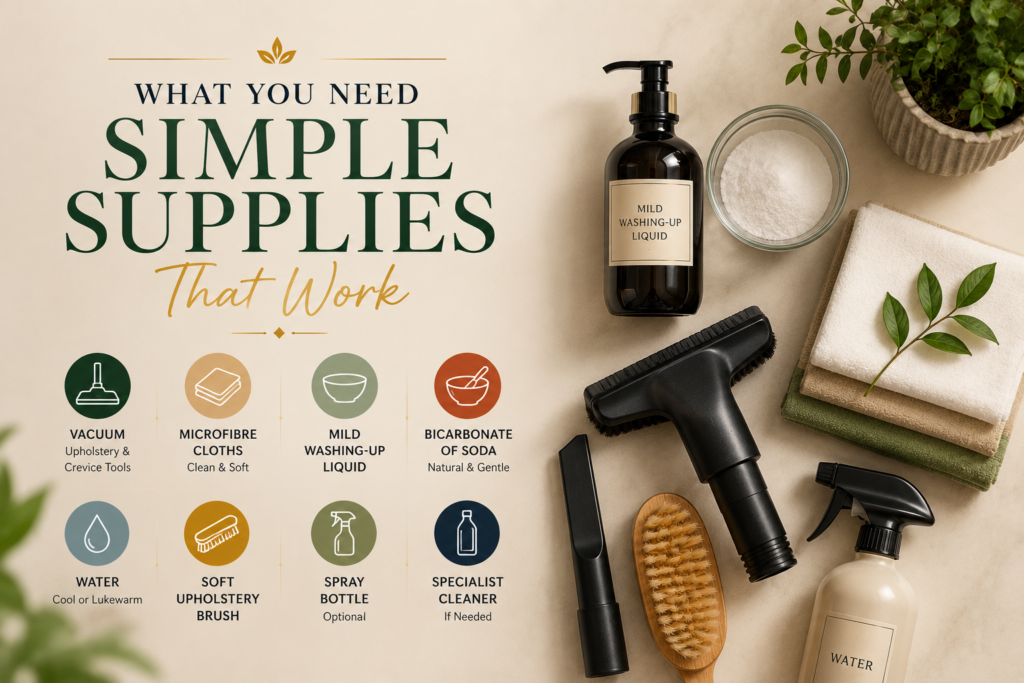
No specialist equipment required. Everything on this list costs very little and handles almost every sofa cleaning job effectively.
- Vacuum cleaner with upholstery and crevice attachments
- Clean white microfibre cloths — several
- Mild washing-up liquid
- Bicarbonate of soda
- Cool or lukewarm water
- Soft upholstery brush
- Spray bottle (optional but useful)
- Specialist cleaner for your fabric type if needed
That’s it. Simple, affordable, and effective for every fabric type.
How to Clean a Fabric Sofa at Home
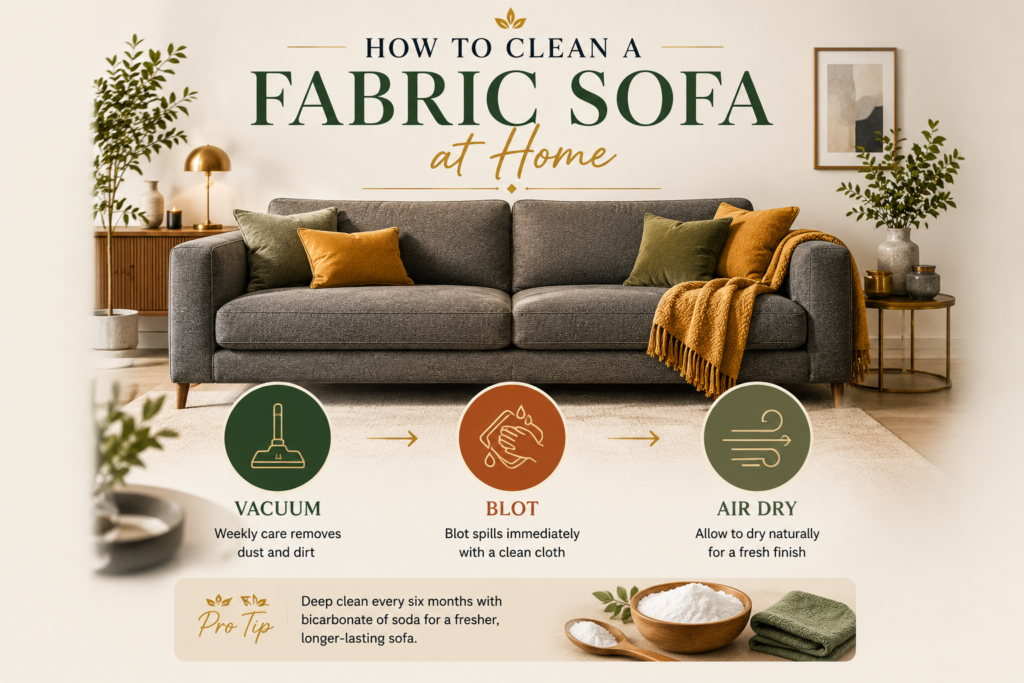
Fabric dark grey sofas are the most common sofa type in UK homes. They’re practical, comfortable, and clean up well when you use the right method.
Weekly care:
Vacuum every surface once a week with the upholstery attachment on medium suction. Remove cushions and vacuum underneath. Use the crevice tool along every seam and gap. Plump and rotate cushions after every use.
For fresh spills — act immediately:
Blot with a clean dry white cloth. Never rub. Press firmly and lift straight up. Work from the outside of the spill inward. Keep blotting with fresh sections of cloth until you’ve absorbed as much liquid as possible. Air dry naturally.
For marks and stains:
Mix one teaspoon of mild washing-up liquid in a cup of cool water. Dip a white cloth into the solution. Wring it out well — the cloth should feel barely damp. Dab at the mark gently from the outside in. Rinse by dabbing with a fresh cloth dampened with plain water. Blot dry. Air dry completely.
Deep clean every six months:
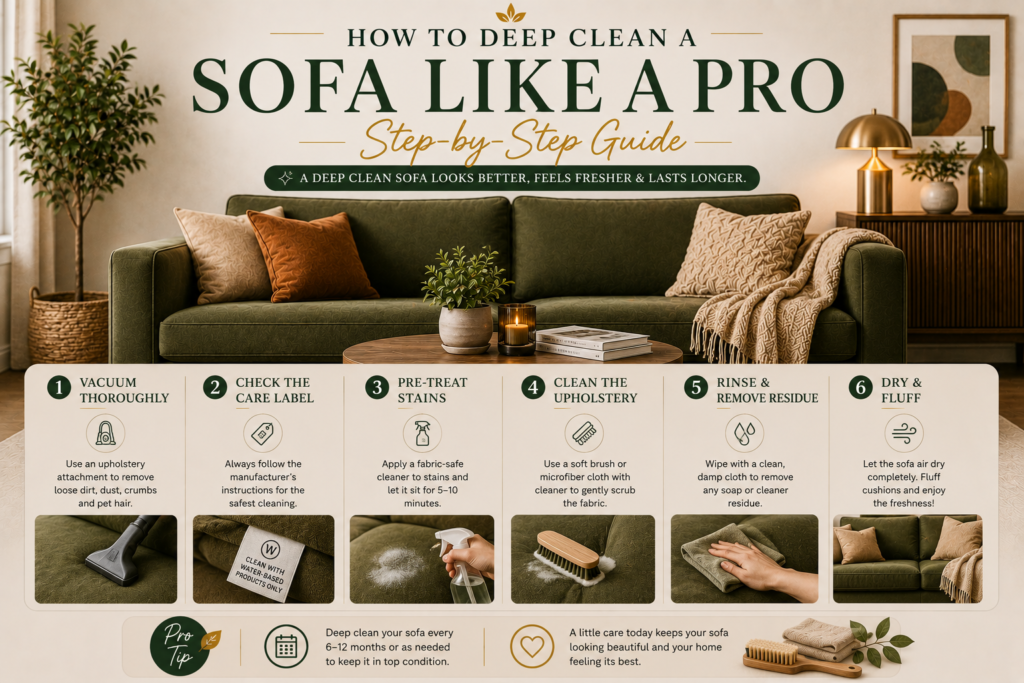
- Remove all cushions. Vacuum every surface.
- Sprinkle bicarbonate of soda across the entire sofa. Leave thirty minutes. Vacuum away completely.
- Spot treat any visible marks with the washing-up liquid solution.
- Wipe down the full surface with a barely damp white cloth in mild solution.
- Rinse with a plain damp cloth. Blot dry.
- Open windows. Air dry fully — two to four hours.
💡 Pro Tip: Deep clean your fabric sofa on a dry day with windows open. UK weather makes timing important — a sofa cleaned on a damp, cold day with closed windows takes much longer to dry and can develop a musty smell in the cushion filling. A dry, mild day with good airflow gives you a fresh, clean result every time.
How to Clean a Leather Sofa at Home
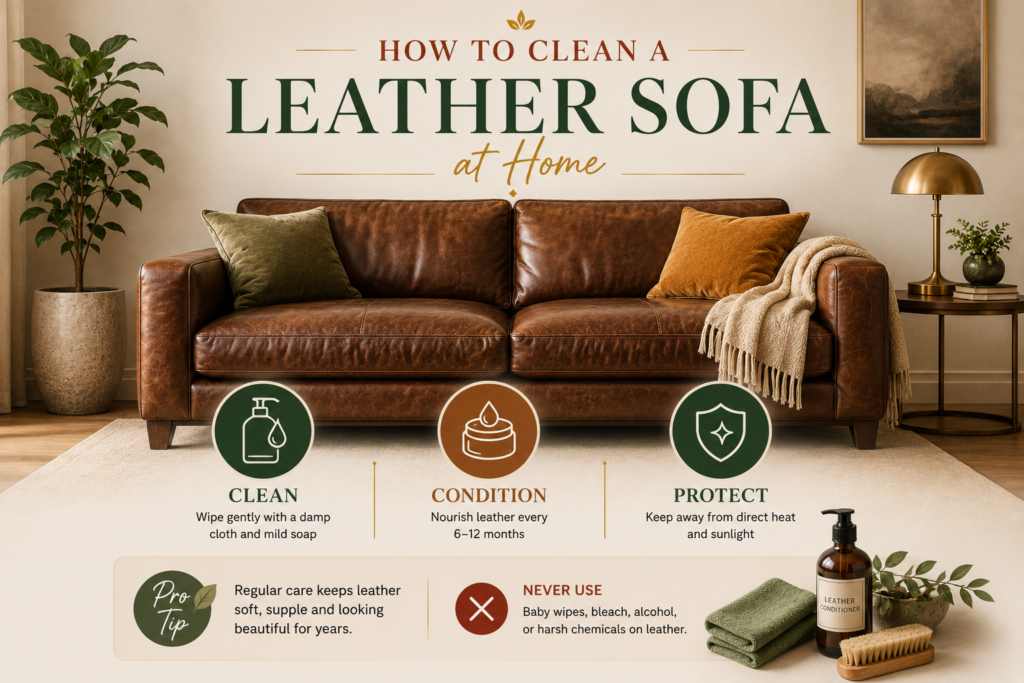
Leather rewards regular care more than any other sofa material. Give it a little attention consistently and it genuinely improves with age.
Weekly care:
Vacuum with the soft brush attachment on low suction. Wipe down with a clean dry microfibre cloth to remove surface dust and skin oils from the armrests.
Monthly clean:
Add two or three drops of pH-neutral soap to a bowl of distilled water — not tap water, which leaves mineral deposits on leather. Dampen a microfibre cloth in the solution and wring out firmly. The cloth should feel barely damp. Wipe the sofa in sections using gentle circular motions. Rinse with a fresh cloth dampened with plain distilled water. Dry immediately with a clean dry cloth.
For fresh spills:
Blot immediately with a dry cloth. Never rub. Most liquid spills on pigmented leather wipe away cleanly when addressed within seconds.
Condition every six to twelve months:
Apply a small amount of dedicated leather conditioner to a clean cloth. Work it into the leather in circular motions across every surface. Allow to absorb. Buff gently with a clean dry cloth. Your sofa will look noticeably richer and feel noticeably softer.
Never use on leather: Baby wipes, washing-up liquid, bleach, furniture polish, vinegar, or hairdryers. These cause permanent damage.
Visit the FurniFolks furniture care guide for detailed guidance on specific leather types and care products.
How to Clean a Velvet Sofa at Home
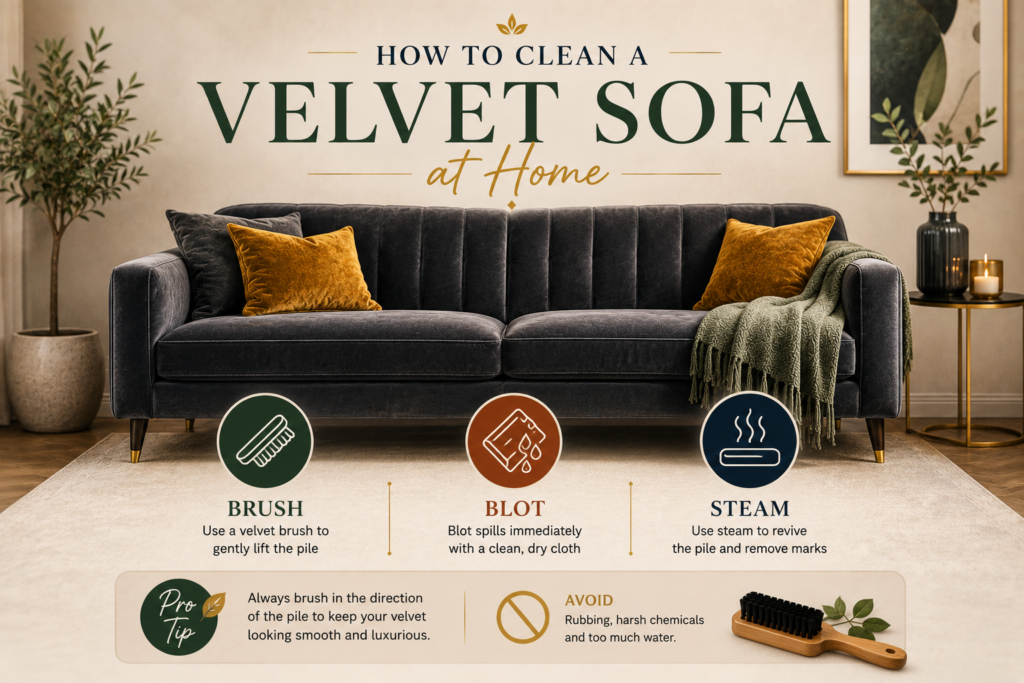
Velvet feels intimidating to clean. In reality, modern plush velvet handles home care very well — you just need the right technique.
Weekly care:
Vacuum on low suction only with a soft brush attachment. Always vacuum in the direction of the pile — never against it. Brush the pile weekly with a soft velvet brush in one consistent direction. This keeps the fabric looking rich and fresh between cleans.
For fresh spills:
Blot immediately with a clean dry white cloth. Never rub — rubbing flattens velvet pile and spreads the spill simultaneously. Keep blotting until you’ve absorbed as much liquid as possible. Air dry naturally. Brush the pile back up once fully dry.
For marks:
Make a foam from two or three drops of mild washing-up liquid whisked into lukewarm water. Use the foam only — not the liquid beneath it. Dab onto the mark with a white cloth using light pressing motions. Work from the outside in. Rinse with a barely damp cloth. Air dry. Brush the pile direction back up once dry.
Never use on velvet: High suction vacuum settings, circular rubbing, direct heat from a hairdryer or iron, or coloured cloths. These cause pile damage that’s difficult to reverse.
💡 Pro Tip: Crushed or flattened velvet pile restores beautifully with steam. Hold a clothes steamer a few centimetres above the affected area — never touching the surface. Move slowly across the flattened section. Brush the pile gently in its natural direction while still warm. Watch the texture spring back to life. It’s honestly one of the most satisfying things you can do for your living room.
How to Clean a Suede Sofa at Home
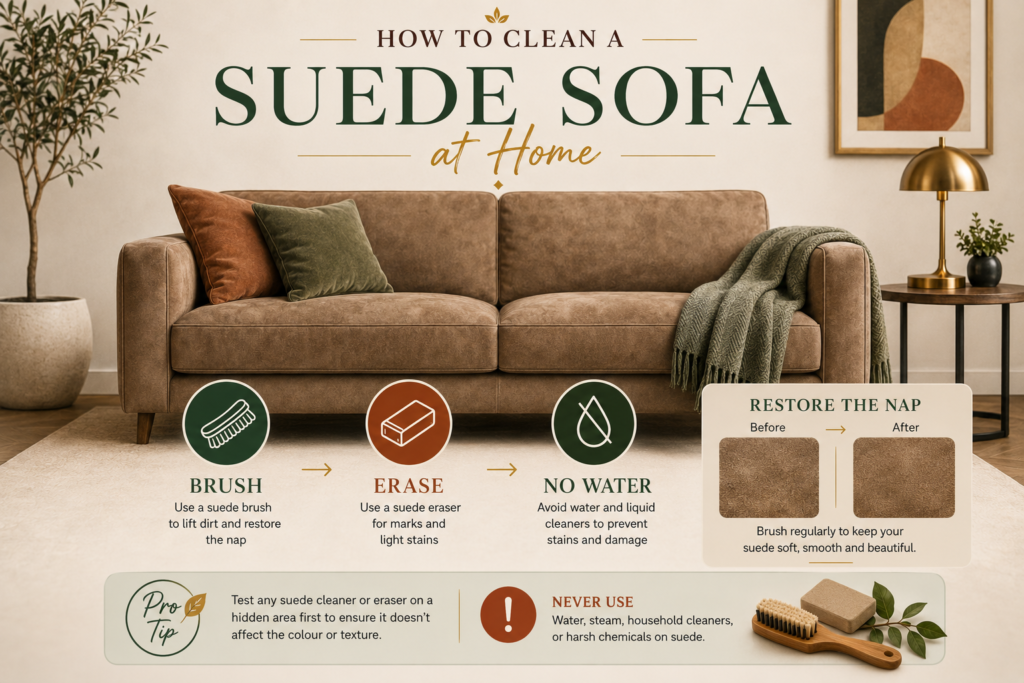
Suede needs a dry approach. Water and suede don’t mix well — moisture causes permanent watermarks on most suede fabrics.
Weekly care:
Brush the entire sofa weekly with a dedicated suede brush. Brush in one direction to lift the nap and remove surface dust. This one habit keeps suede looking consistently good with minimal effort.
Vacuum on very low suction with a soft brush attachment. Be gentle — suede nap is delicate.
For fresh spills:
Blot immediately with a clean dry cloth. Remove as much liquid as possible before it soaks in. Allow to dry completely at room temperature. Once fully dry, brush the nap back up with a suede brush.
For dry marks:
Use a suede eraser — available from most UK shoe shops and homeware stores. Rub very gently over the mark in one direction. The eraser lifts surface marks without moisture. Follow with a suede brush to restore the nap.
For stubborn stains:
Use a specialist suede cleaner spray — always test on a hidden area first. Follow the product instructions carefully. Allow to dry fully. Brush the nap back up with a suede brush.
Never use on suede: Water-based cleaning solutions, washing-up liquid, or excessive moisture of any kind. Always use dry or solvent-based methods only unless your sofa’s label specifically states otherwise.
How to Remove Common Stains From Any Sofa
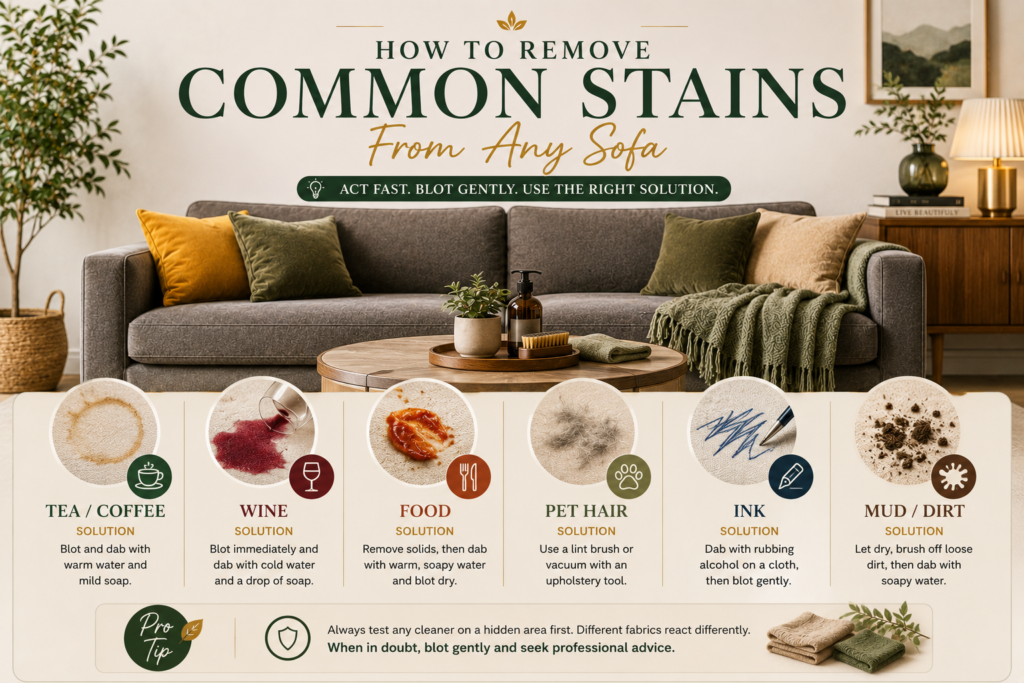
| Stain | First Action | Treatment | Never Do |
|---|---|---|---|
| Tea / Coffee | Blot immediately | Mild soap solution, dab from outside in | Rub or use hot water |
| Red wine | Blot — act fast | Sparkling water first, then soap solution | Leave it to dry |
| Grease / Food | Blot surface residue | Bicarbonate of soda to absorb, then soap solution | Use hot water |
| Mud | Leave to dry completely | Brush away dried mud, then soap solution | Try to clean wet mud |
| Ink / Biro | Blot — don’t spread | Rubbing alcohol on white cloth, dab carefully | Rub vigorously |
| Pet accidents | Blot all liquid | White vinegar solution to neutralise, then bicarb | Leave it to set |
| Chewing gum | Ice bag to harden | Lift away hardened gum cleanly | Pull at soft gum |
| Odours | Ventilate well | Bicarbonate of soda sprinkled, left overnight, vacuumed | Spray air freshener directly |
How to Deodorise a Sofa Naturally
Sofas absorb smells over time. Pet odour. Cooking smells. The general build-up of everyday life. Bicarbonate of soda handles all of it.
Sprinkle bicarbonate of soda across the entire sofa surface. Be generous. Leave for a minimum of thirty minutes — ideally several hours or overnight. Vacuum away every trace with the upholstery attachment.
The bicarbonate neutralises odour molecules from within the fabric rather than masking them with fragrance. The result is a sofa that genuinely smells fresh rather than just perfumed.
For persistent pet odours, a solution of equal parts white vinegar and water applied lightly to the affected area — blotted, not rubbed — neutralises the odour at source before the bicarbonate treatment. Allow to dry before applying the bicarb.
The Sofa Cleaning Mistakes Most UK Homeowners Make
These are the errors that cause permanent damage. Learn them. Avoid them.
For velvet, follow the specific velvet sofa care instructions before you vacuum or treat any marks, since the pile can be damaged by the wrong cleaning method.
Rubbing stains — Always blot. Rubbing spreads the stain wider and pushes it deeper into the fabric. This single mistake turns a small, manageable stain into a large, set one.
Using too much water — Over-wetting fabric causes watermarks, encourages mould inside the sofa frame, and takes days to dry in a UK home. Always use damp — never wet.
Skipping the cleaning code check — Using a water-based cleaner on an S-coded fabric causes permanent damage. Thirty seconds checking the label prevents this entirely.
Using coloured cloths — Dye transfers from coloured cloths onto light sofa fabrics. Always use white cloths without exception.
Drying with heat — Hairdryers and radiators set stains permanently and damage delicate fabrics. Always air dry at room temperature with good ventilation.
Ignoring small marks — A small mark cleaned immediately takes thirty seconds. The same mark left for a week requires thirty minutes of careful work. Deal with marks the moment you see them.
💡 Pro Tip: Set a monthly reminder on your phone for a quick ten-minute sofa check — vacuum, plump, rotate cushions, and treat any small marks you find. This monthly habit takes less time than a single deep clean and keeps your sofa looking consistently great year-round. Small regular effort beats infrequent intensive effort every single time.
When to Call a Professional | Furnifolks UK Delivers the Best
Home cleaning handles the vast majority of everyday sofa care. But some situations call for professional help.
Call a professional upholstery cleaner when:
- Stains won’t lift after repeated home attempts
- The sofa has a persistent odour that home methods can’t shift
- Mould or mildew has developed in the fabric
- Your sofa carries an S or X cleaning code
- The sofa hasn’t been professionally cleaned in three or more years
- You’re dealing with a delicate or high-value fabric — antique velvet, silk, or premium aniline leather
A professional clean every two to three years removes deep-seated grime, embedded allergens, and odours that home methods simply cannot fully address. It’s a worthwhile investment in a piece of furniture you use every single day.
Sofa Cleaning Schedule — Your Complete Quick Reference
| Task | Fabric | Leather | Velvet | Suede |
|---|---|---|---|---|
| Vacuum | Weekly | Weekly | Weekly (low suction) | Weekly (very gentle) |
| Wipe / brush | — | Monthly damp cloth | Weekly pile brush | Weekly suede brush |
| Deodorise | Monthly bicarb | — | Monthly bicarb | Monthly bicarb |
| Deep clean | 6–12 months | Monthly clean + 6 monthly condition | 6–12 months | 6–12 months |
| Professional | Every 2–3 years | Every 3–5 years | Every 2–3 years | Every 2–3 years |
For specific fabric and care guidance on every sofa in the FurniFolks range — visit the FurniFolks sofa collection and the dedicated furniture care guide.
Summing Up
Cleaning a sofa at home doesn’t need to feel complicated. The principles are simple regardless of fabric — check the code, vacuum first, blot never rub, use minimal moisture, and air dry completely. Get those five things right and you handle almost everything your sofa encounters in everyday UK life.
The difference between a sofa that looks great after five years and one that looks tired after two isn’t luck. It’s consistent, simple care using the right methods. Ten minutes a week and a deep clean twice a year — that’s genuinely all it takes.
Your sofa works hard for your home every single day. A little care in return keeps it beautiful for years. And that feels like a very good investment.
Frequently Asked Questions
How do I clean a sofa at home without a professional? Vacuum weekly with an upholstery attachment, spot clean marks immediately for any seater sofa, like a 5 seater sofa or a 1 seater, with a mild washing-up liquid solution in cool water using a white cloth, deep clean every six months with bicarbonate of soda and a barely damp cloth. Always check the cleaning code label first and always blot — never rub.
What household products can I use to clean a sofa? Mild washing-up liquid, bicarbonate of soda, white vinegar, cool water, and white microfibre cloths handle most sofa cleaning jobs effectively. For leather sofas, use distilled water and a pH-neutral soap. Always check the sofa’s cleaning code before using any product.
How do I get rid of sofa smells at home? Sprinkle bicarbonate of soda across the entire sofa surface. Leave for at least thirty minutes — longer for persistent smells. Vacuum away completely. Repeat if needed. For pet odours, apply a diluted white vinegar solution first, allow to dry, then follow with the bicarbonate treatment.
How do I deep clean a sofa at home? Vacuum thoroughly, treat with bicarbonate of soda for thirty minutes and vacuum again, spot treat all visible marks, wipe down the full surface with a barely damp mild solution, rinse with a plain damp cloth, and air dry fully with windows open. The full process takes around ninety minutes plus drying time.
Can I use a steam cleaner on my sofa? Only if the care label confirms it’s safe for your specific fabric. Fabric sofas with W or WS codes can generally handle careful steam cleaning. Velvet, suede, and aniline leather cannot. Always check the code and test on a hidden area before steaming any visible surface.
How often should I clean my sofa? Vacuum weekly. Deep clean every six to twelve months. Spot treat stains the moment they happen — never leave them to set. Book a professional upholstery clean every two to three years for the deepest, most thorough result.