
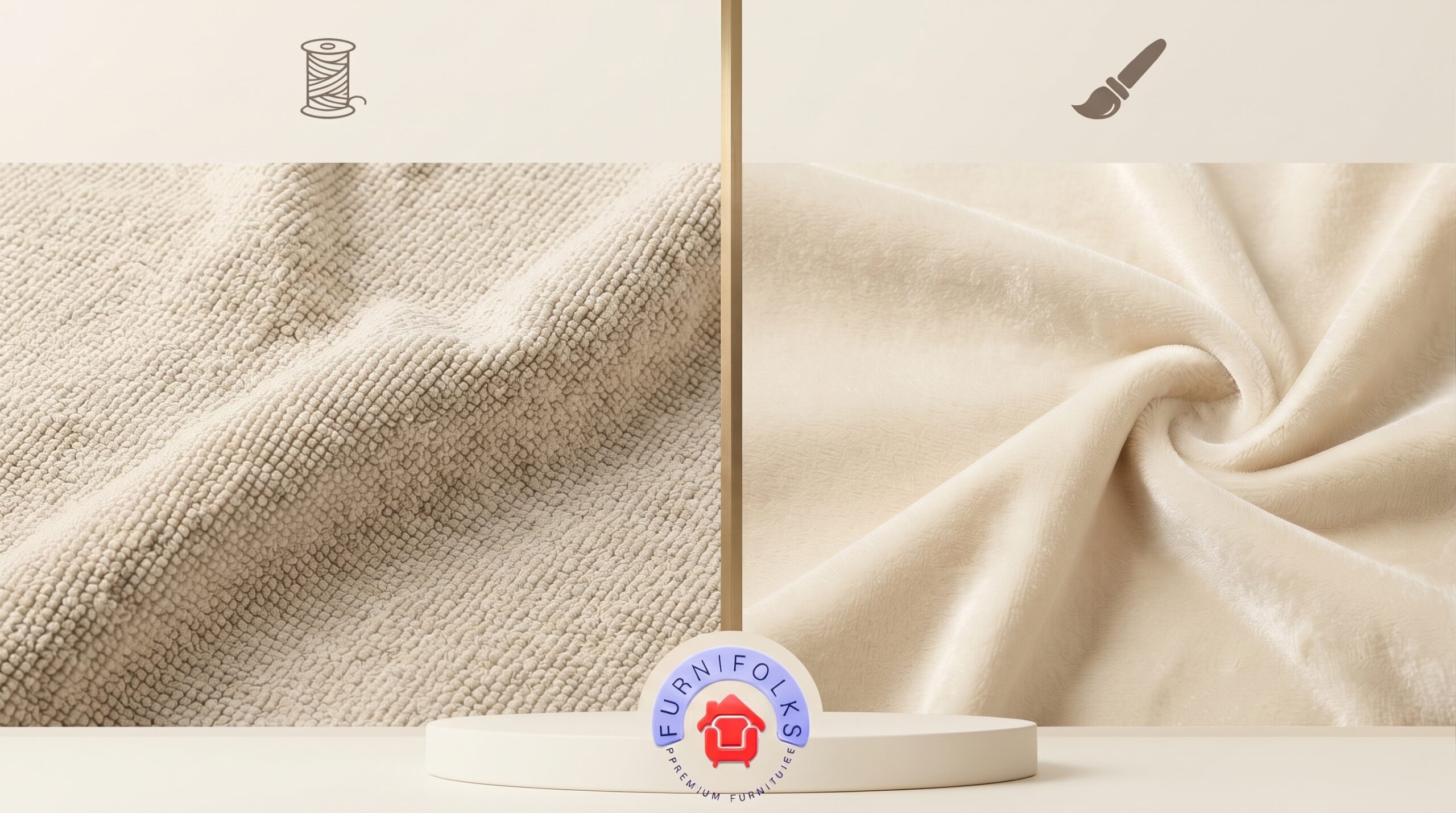
Quick Answer: Chenille wins for durability. It’s tougher, hides dirt, and bounces back after being squashed. Plush velvet is softer and more luxe but shows footprints and needs careful maintenance. Both last 7–10 years if treated right. Choose chenille for families. Choose velvet for careful couples.
You’re torn between two gorgeous options. Both feel amazing. But here’s the thing—they age completely differently. Understanding chenille vs plush velvet sofa durability changes everything when you’re deciding which to buy.
One becomes more beautiful over time. One starts looking tired after two years of family life. Here’s what actually happens to each fabric over time.
Chenille vs Plush Velvet Sofa Durability: The Real Difference

Both fabrics look stunning in the showroom. Both feel incredible. But chenille vs plush velvet sofa durability tells completely different stories once you bring them home.
Chenille has a looped weave. It’s chunky. It feels cosy and warm. The texture hides dirt. The pile bounces back after you sink into it.
Plush velvet has a smooth pile. It feels like butter. It catches light beautifully. But it shows footprints. It flattens under pressure. It needs careful handling.
One is forgiving. One requires you to respect it. The choice depends on how you actually live.
Chenille Sofa Durability: The Workhorse Fabric
Chenille vs Plush Velvet: Understanding Chenille’s Advantages
Chenille starts as a looped weave. Those loops are what make it special. They resist daily wear brilliantly.
Sit on it. The pile bounces back. Jump on it. Still bounces back. This is why chenille lasts.
Martindale rub count—the industry durability test—ranges 15,000–25,000 for quality chenille. That’s high. That means tough.
Compare that to plush velvet at 8,000–12,000. Chenille wins that test every single time.
Real-World Wear: How Chenille Ages
After one year: Looks nearly identical to new. Colour stays vibrant.
After three years: Barely noticeable wear. Maybe slight softening of texture. Still looks fresh.
After five years: Still beautiful. No major flattening. Colour holds well.
After eight years: This is where it shows age. But age looks good on chenille. It softens rather than damages.
After ten years: Might start showing wear. But many families report theirs looking good at a decade.
Chenille and Pilling: What Actually Happens
Pilling is those fuzzy bobbles that form on fabric. Chenille can pill slightly. But it’s a minor issue.
Why? The loops mean pills form on the surface. They don’t destroy the fabric underneath. You pick them off with a lint roller. Gone.
This is different from fabric that tears or separates. Chenille just gets a few fuzzy bits. Easily fixed.
Plush Velvet Durability: Beautiful But Demanding
Chenille vs Plush Velvet: Why Velvet Needs Care
Plush velvet feels incredible. Smooth. Luxurious. Light-reflective. But that softness comes with a cost.
The pile is dense but delicate. Pressure flattens it. Friction damages it. Spills set into it. This is why velvet needs you to respect it.
Martindale rub count for plush velvet: 8,000–12,000. Lower than chenille. This matters more than you’d think.
Real-World Wear: How Velvet Ages
After one year: Slight flattening where you sit. Visible footprints appear. Colour looks vibrant still.
After three years: Obvious worn patches. The sitting area looks noticeably different from armrests. Flattening is permanent in those spots.
After five years: Regular wear areas look tired. Colour may fade unevenly. Footprints show constantly.
After seven years: The sofa looks old. Not broken, but definitely used. Sitting spots are visibly worn.
After ten years: Most velvet sofas look quite tired at this point. The luxury feel has faded.
Plush Velvet and Footprints: The Unavoidable Reality
This is velvet’s biggest weakness. Walk across it, and fibres flatten in your footstep direction. The footprint is visible because the pile angle changed.
Once flattened, you can’t fully restore it. Gentle steam and brushing help. But the footprint doesn’t completely disappear.
With a family? Footprints become constant. Kids jump on it. Guests walk across it. Everyone leaves marks.
Head-to-Head Durability Comparison
| Factor | Chenille | Plush Velvet |
|---|---|---|
| Rub resistance (Martindale) | 15,000–25,000 (High) | 8,000–12,000 (Lower) |
| Bounce-back after sitting | Excellent | Poor |
| Footprint visibility | Minimal | Very visible |
| Pilling risk | Minor | None (but wear is different) |
| Flattening in wear areas | Minimal | Significant |
| 5-year appearance | Looks fresh | Shows obvious wear |
| 10-year appearance | Still beautiful | Looks tired |
| Recovery from accidents | Good | Poor |
| Stain susceptibility | Moderate | High |
| Daily living forgiveness | Very forgiving | Demands care |
Maintenance Reality Check: What You’ll Actually Do
Maintaining Chenille vs Plush Velvet Durability
Chenille: Vacuum weekly. Rearrange cushions monthly. Spot-clean spills. That’s genuinely it.
Velvet: Brush gently with soft bristles weekly. Vacuum with extreme care. Avoid liquids. Professional clean every 2–3 years. Much more involved.
Chenille requires basic care. Velvet requires specialist care.
Stain Removal: The Practical Difference
Spill tea on chenille: Blot. Mild soap and water. Usually comes clean.
Spill tea on velvet: Blot immediately. Use specialist velvet cleaner. Might still set. Risk of permanent stain.
This practical difference matters every single day in a family home.
💡 Pro Tip: Velvet needs specialist cleaner. Chenille handles spot cleaning at home. Budget £50–100 annually for velvet upkeep. Chenille? A good vacuum and water spray.
The Durability Showdown: Testing Real Fabrics
The Rub Test (You Can Do This)
Grab a cushion. Rub your hand back and forth 100 times. Chenille bounces. Velvet shows a flat patch.
That’s your answer right there. That’s what happens daily in a lived-in home.
Fabric Weight Matters
Heavier chenille (more tightly woven) outlasts lighter chenille. Same with velvet. Quality affects durability within each fabric type.
Quality matters more than fabric choice. A high-quality velvet might outlast cheap chenille.
Which Fabric Wins Long-Term: The Honest Answer
If you have kids or pets: Chenille wins decisively.
Chenille stays beautiful longer. Hides wear better. Bounces back from daily life. Eight to ten years looking fresh is realistic.
If you’re a careful couple with no pets: Velvet is beautiful.
If you are comparing a 5 seater sofa for everyday use, the fabric choice matters because chenille and plush velvet age very differently.
If you are comparing fabrics for a busy home, it can also help to think about how easy nearby storage like sliding wardrobes is to keep tidy.
Velvet still looks beautiful at seven years with proper care. Footprints are annoying but not devastating if you’re careful about walking on it.
If you want lowest maintenance: Chenille is obvious.
Velvet demands specialist cleaning. Chenille handles home spot-cleaning. This matters practically and financially over time.
If you want the luxury feel: Velvet delivers that.
But understand what you’re signing up for. That luxury feel comes with maintenance demands and visible wear.
Real Families: What They Report
Family One: Two young children, golden retriever
Chose: Chenille
Result after 3 years: Still looks nearly new. Kids jump on it daily. Dog naps on it constantly. Zero regrets.
Family Two: Careful couple, no pets
Chose: Plush velvet
Result after 3 years: Beautiful but showing footprints. Professional cleaning twice yearly. Enjoying it but conscious of wear.
Family Three: Mixed household, active cats
Chose: Chenille with throw blanket
Result after 3 years: Looks fantastic. Throw blanket protects high-wear areas. Sofa underneath looks new.
Family Four: Minimalist, no children, minimal visitors
Chose: Plush velvet
Result after 5 years: Still luxurious. Very few footprints because minimal traffic. Professional cleaning once yearly. Looks beautiful.
Cost Matters: What You’re Actually Paying
Chenille and plush velvet typically cost similar amounts upfront. Both are mid-range fabrics.
But total cost of ownership differs dramatically.
Chenille: Buy it. Vacuum weekly. Spot-clean as needed. Professional cleaning every 3–4 years. Total over ten years: sofa cost plus minimal extras.
Velvet: Buy it. Specialist cleaning supplies. Professional cleaning every 2–3 years. Potential replacement sooner. Total cost significantly higher.
FAQ
Can I use regular cleaner on plush velvet?
No. Use velvet-specific products only. Regular cleaners flatten the pile permanently.
Does chenille wear out faster than velvet?
No. The opposite. Chenille’s looped weave resists daily friction better.
Which is cheaper to buy?
Similar price. Velvet may cost slightly more. But chenille is cheaper long-term.
Can you fix flattened velvet?
Partially. Steam gently, then brush. Won’t fully recover. Prevention is better.
Is one fabric better for families?
Definitely chenille. It forgives daily life much better than velvet.
Can I use a throw blanket on either?
Yes. Smart move. Protects the fabric underneath. Washable blanket costs £30–50.
Which fabric lasts longer realistically?
Chenille in real family homes. Velvet in careful, quiet households.
Choose Based on Your Life
Chenille if: You have kids, pets, active household, want low maintenance, value durability.
Velvet if: You’re careful, have minimal traffic, enjoy luxury feel, willing to maintain it properly.
Both are beautiful. Both can last a decade. But they require different expectations and different households.
Explore Your Options
Browse our Madrid Chesterfield collections in both chenille and plush velvet. All FurniFolks sofas come with a 10-year durability guarantee and free care guide.
Explore Chenille Sofas
Explore Plush Velvet Sofas
Related reads:
- How to Clean Jumbo Cord Sofa: Weekly Steps
- Best Fabric Sofa for Dogs UK
- Best Fabric for Sofa with Cats UK